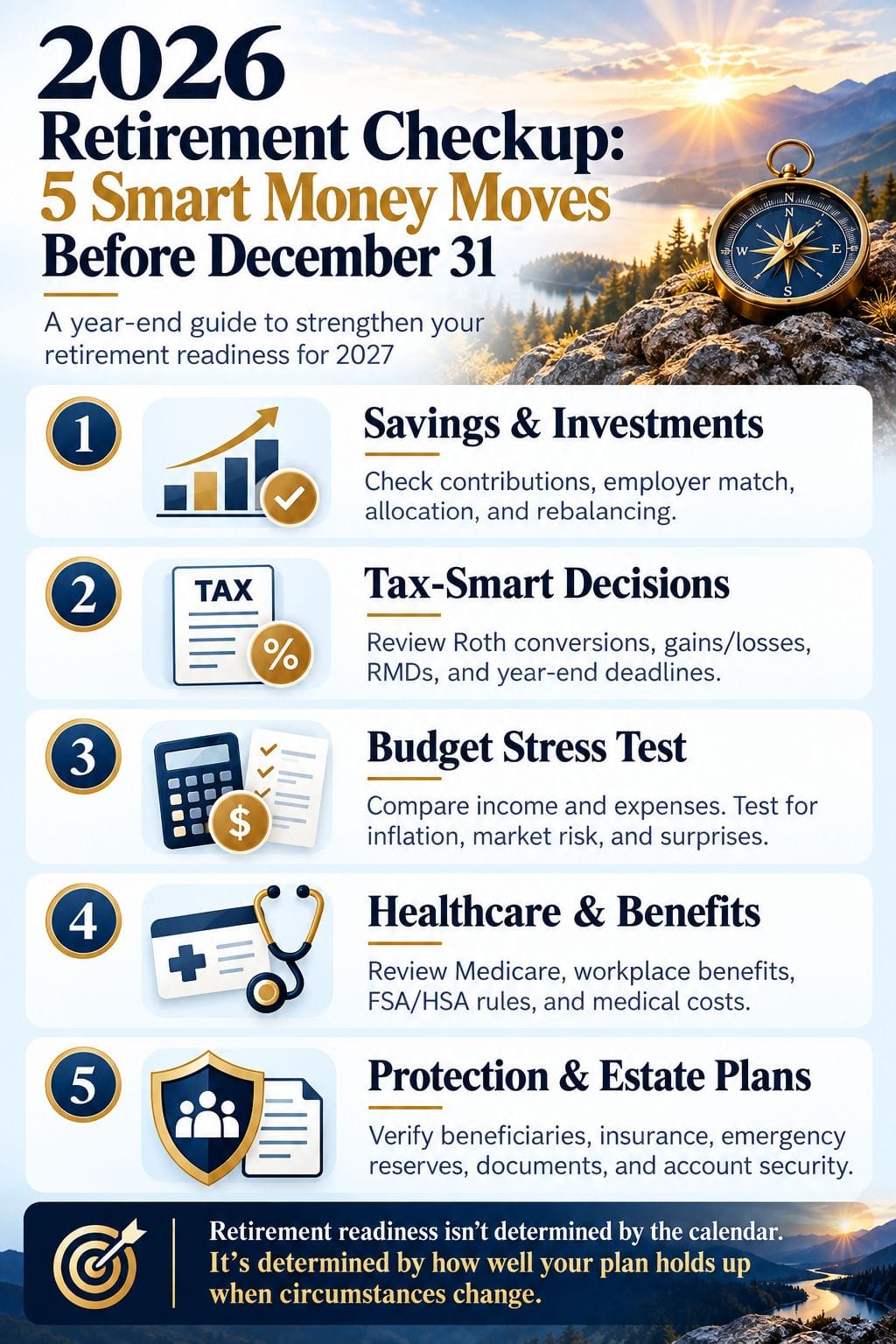
2026 Retirement Checkup: 5 Smart Money Moves to Make Before December 31
Here are five moves worth making to make sure your financial plan is ready for 2027.


The final quarter of 2026 is here.
Before holiday spending takes over, revisit your retirement assumptions, check key deadlines, and make sure your financial plan is ready for 2027.
Here are five moves worth making before the calendar turns.
1. Give Your Retirement Savings and Investments a Checkup
Are you saving enough, and is your money invested appropriately for your retirement timeline?
Review contributions to your 401(k), 403(b), IRA, and other retirement accounts. Make sure you're capturing any available employer match.
For 2026, the employee contribution limit for most 401(k) plans is $24,500. Workers 50 and older can generally contribute an additional $8,000, while those ages 60–63 may qualify for an $11,250 catch-up contribution if their plan allows.
Review your investment allocation, too. Strong stock-market performance may have left your portfolio more heavily invested in equities than you intended.
Your move: Check your contribution rate, employer match, asset allocation, and retirement timeline. Consider rebalancing if your portfolio has drifted from your intended strategy.
2. Make Tax-Smart Decisions Before Year-End
December 31 is an important deadline for several retirement-related tax decisions.
Consider whether a Roth IRA conversion makes sense given your 2026 income and expected future tax situation. Conversions generally create taxable income in the year completed.
Review taxable investments for potential capital gains or tax-loss harvesting opportunities. If you're subject to required minimum distributions, confirm that you've satisfied your 2026 obligation.
Charitable contributions may also offer tax-planning opportunities, including qualified charitable distributions for eligible IRA owners.
Not every deadline falls on December 31. Eligible taxpayers generally have until April 2027 to make 2026 IRA contributions.
Your move: Estimate your 2026 taxable income and identify decisions requiring action before year-end. Seek professional advice before making consequential tax moves.
3. Stress-Test Your Retirement Budget for 2027
Inflation doesn't just make life more expensive. It can undermine the assumptions behind your retirement plan.
Compare your actual 2026 spending with your budget. Pay particular attention to housing, groceries, transportation, insurance, and healthcare.
If you're approaching retirement, estimate your dependable monthly income from Social Security, pensions, and other sources. Compare that income with essential expenses.
The difference is your retirement-income gap, the amount your investments or other resources must cover.
Then ask a tougher question: What happens if inflation remains elevated, markets decline, or you face an unexpected expense?
Your move: Update your projected retirement expenses and test whether your savings and income strategy can withstand unfavorable conditions.
4. Review Healthcare Coverage and Employee Benefits
Healthcare is one of retirement's most important financial uncertainties.
If you're Medicare-eligible, annual open enrollment runs from October 15 through December 7. Review 2027 coverage, including premiums, prescription costs, provider networks, deductibles, and potential out-of-pocket expenses.
If you're still working, examine your employer's upcoming benefits elections. Compare health insurance options and evaluate whether you're using available benefits effectively.
Have a flexible spending account? Check its balance and your employer's spending, carryover, or grace-period rules.
Eligible health savings account owners should also review contribution opportunities. Unlike flexible spending accounts, HSA balances generally carry forward from year to year.
Remember that Medicare generally doesn't cover long-term custodial care.
Your move: Review your healthcare coverage, expected medical expenses, and any benefits or account balances requiring action before year-end.
5. Protect Your Finances, Beneficiaries, and Estate Plans
Building retirement wealth matters. Protecting it matters just as much.
Review your emergency reserves and outstanding debts. Could an unexpected medical bill, home repair, or loss of income force you to withdraw retirement savings prematurely?
Examine insurance coverage, including homeowners, auto, life, and disability policies where appropriate.
Check beneficiary designations on retirement accounts and life insurance policies. Outdated designations can create unintended consequences, even when you've updated your will.
Review your will, powers of attorney, and healthcare directives, particularly if your family circumstances changed during 2026.
Finally, strengthen account security with multifactor authentication and updated passwords.
Your move: Complete a financial protection audit. Verify beneficiaries, insurance coverage, emergency reserves, and essential estate documents.
The Bottom Line: Finish 2026 With Fewer Assumptions
Year-end retirement planning isn't about making five major financial changes before December 31.
It's about identifying what deserves attention, separating firm deadlines from flexible decisions, and correcting assumptions that no longer reflect reality.
A few deliberate moves today can strengthen your financial position tomorrow.
Retirement readiness isn't determined by the calendar. It's determined by how well your plan holds up when circumstances change.
Retirement Readiness Radar provides educational information, not individualized financial, tax, or legal advice. Consult qualified professionals regarding your circumstances.